
Operating-System Engineering: What to Decide Before You Build
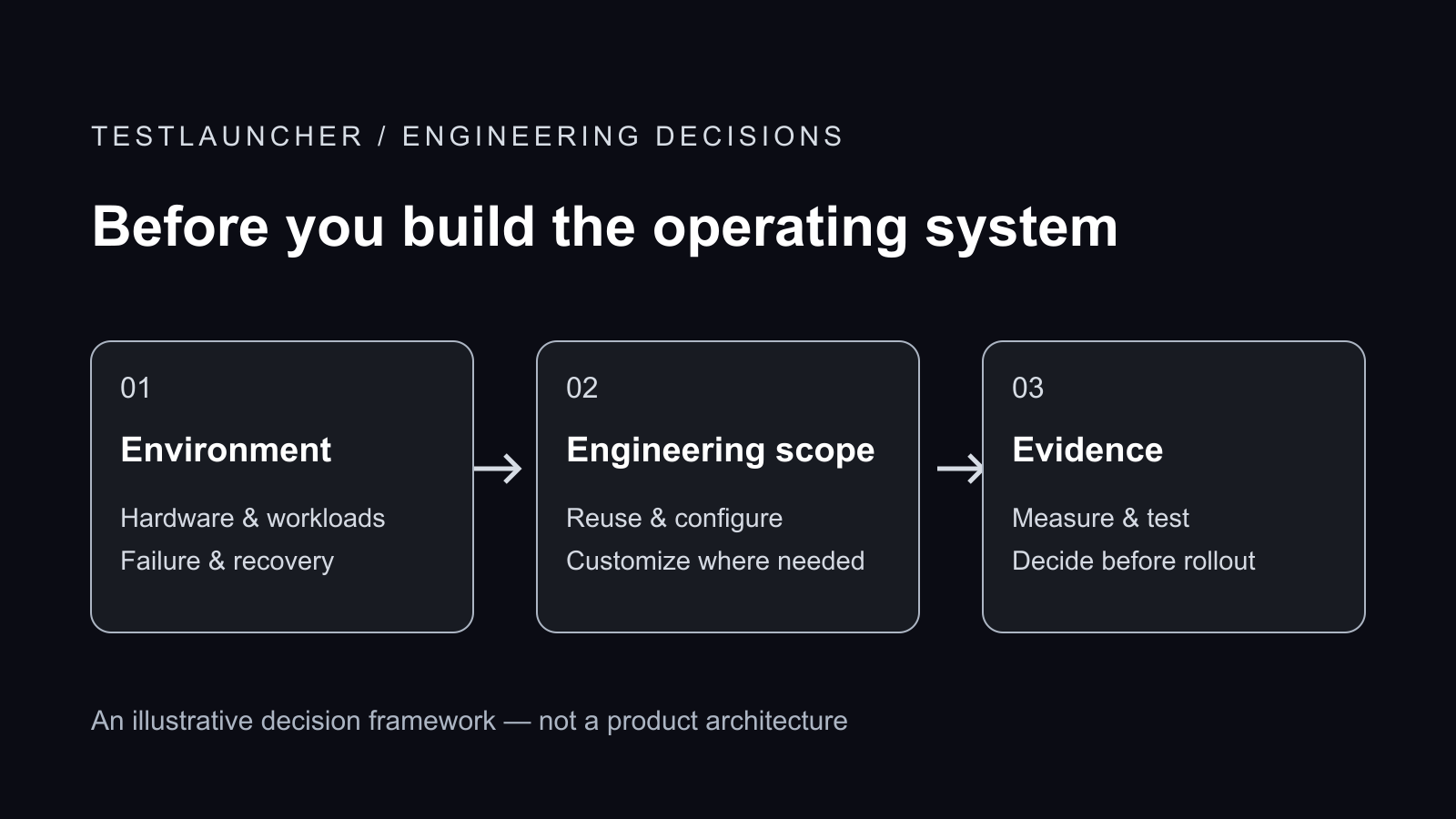
Operating-system engineering starts with the environment a system must survive: its hardware, workloads, connectivity, recovery requirements and maintenance life. Define those constraints before deciding whether to configure an existing foundation, build a specialized system image, or change lower-level software.
For defence, public-sector and dual-use innovators, a successful demonstration is a beginning. The next question is what evidence makes the system dependable in its intended operating environment. At TestLauncher, that question connects custom platforms, operating-system engineering and quality expertise. Canada is our first deployment market and current focus; we build for organizations across NATO member countries.
First, locate the actual constraint
“We need a custom OS” can describe several very different scopes. Separate them before estimating a build:
- Application or integration work: the gap is in a workflow, device interface or exchange between systems. A custom platform may address it without changing the operating system.
- A configured operating environment: an existing foundation may fit once its services, permissions, packages and deployment settings are controlled.
- A specialized image or deeper engineering: boot behaviour, drivers, updates, scheduling or recovery may require work below the application layer. Identify exactly which requirement makes that necessary.
Prefer the smallest change that meets the requirement and can be maintained. A larger custom scope creates more responsibility for testing, dependency changes, support and future hardware revisions. Our custom-platform decision guide helps establish that boundary.
Define behaviour under pressure
An engineering brief should describe both ordinary operation and failure conditions. Write down the target hardware, supported interfaces, workload limits, startup expectations and the actions an operator must be able to take.
If timing matters, distinguish average throughput from the longest acceptable delay. Specify the workload and hardware on which timing will be measured. For Linux-based options, the kernel documentation explains how PREEMPT_RT changes preemption and interrupt handling to reduce scheduling latency. Selecting that capability is still a starting point for evaluation on the intended system, not evidence that an application’s deadline has been met.
For disconnected operation, decide which functions remain available, how much data can be retained locally, what happens when storage fills, and how conflicting records are reconciled after reconnection. Include power loss and interrupted writes in the investigation.
Treat updates and recovery as part of the product
Before a field pilot, establish who can authorize an update, how its origin and integrity will be checked, and what happens if installation stops halfway through. Define recovery and rollback expectations alongside the conditions under which an older version must no longer be used.
Plan how operators identify the software version, configuration and hardware involved in an incident. Decide which logs can leave a device, who may access them, and how long they should be retained. A diagnostic path that depends on permanent connectivity may not fit the deployment.
NIST’s Secure Software Development Framework, SP 800-218, provides practices and a shared vocabulary for discussing software security with suppliers. It is a useful reference for planning evidence; citing it does not establish certification or procurement eligibility.
Example scenario: an intermittently connected inspection device
This is a hypothetical scoping example, not a customer project or a claim about a released TestLauncher product.
Imagine a manufacturing inspection device that records observations locally and synchronizes them when a connection becomes available. The team needs to know whether the existing operating environment can support predictable startup, bounded local storage and recovery after power interruption.
A focused investigation could compare a configured existing foundation with a specialized image. It could measure startup under an agreed workload, interrupt power during a write, fill the local queue, and test reconnection with repeated or conflicting records. Each test needs an expected result and an explicit decision about what would prevent a pilot from proceeding.
The output might be a recommendation to retain the current foundation and change the application. That is a useful result if it resolves the constraint with less maintenance burden. These questions also apply to smart manufacturing and clean-technology deployments, with criteria adapted to the actual operating environment.
Agree on concrete deliverables
A proposed discovery engagement could produce:
- An operating-environment brief covering hardware, interfaces, workloads, connectivity and failure behaviour.
- An options assessment that separates configuration, platform integration and operating-system changes, including maintenance responsibilities and unresolved risks.
- A bounded prototype and evidence plan with test conditions, acceptance criteria, update and recovery scenarios, and a decision on the next investment.
These are proposed deliverables to scope together, not a fixed package or a promised performance outcome. Where software interacts with physical equipment, identify the safety responsibilities and specialist review needed before deployment.
Keep deployment claims specific
Canadian ownership does not establish where a particular system’s data is stored or accessed. Define the locations of production systems, backups, telemetry, support access and external services for the engagement. See our Security & Trust page for the distinction between current deployments and planned options.
TestLauncher’s operating-system engineering engagements are available today. Our Canadian operating-system product and sovereign-email initiative remain in research and development; neither is released. bugAgent is our available quality platform, with conversational capabilities in active development; not yet released. Its current production hosting is in the US; Canadian production hosting and residency remain planned options for new clients, subject to deployment planning and agreement.
Bring the hardest constraint to discovery
Bring the hardware or platform you are working with, the behaviour you cannot reliably achieve, and the evidence you need before committing to deployment. Book a discovery call to define the next engineering decision.