
When Does Your Innovation Need a Custom Platform?
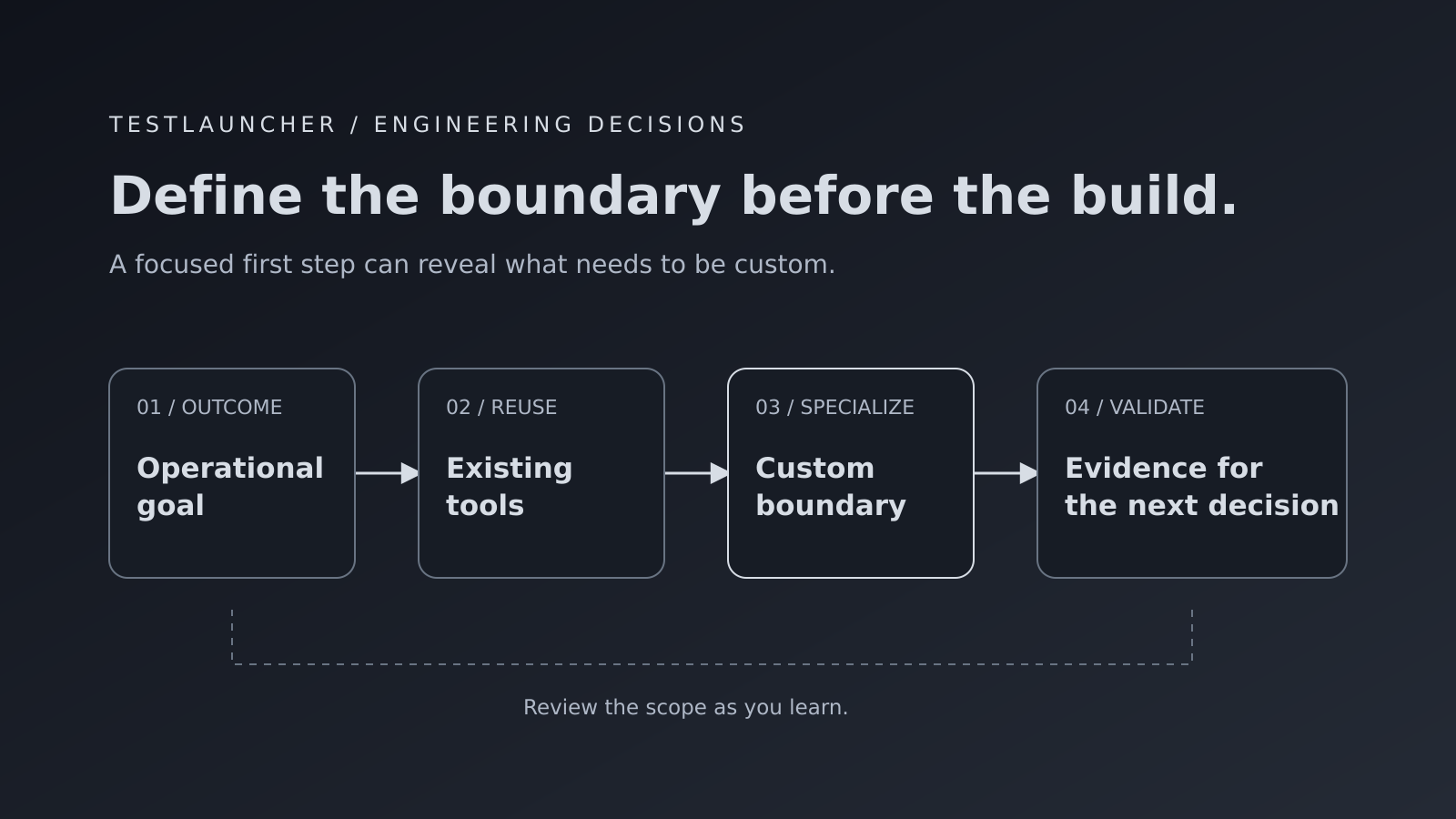
A custom software platform makes sense when an important requirement cannot be met well by existing tools and the benefit justifies building and maintaining something specialized. At TestLauncher, we start with that decision before committing to a larger build.
For a Canadian innovation team, the difficult question is often more specific than “Can we build this?” It is “Which part needs to be ours, and what should we reuse?” AI-assisted development makes that distinction worth examining carefully: producing an implementation is only one part of operating a useful system.
Question 1: What must happen in the real workflow?
Describe the outcome before naming the technology. Which person or device needs to act? What information must be available? What happens when a connection fails or a record arrives late?
Consider an illustrative manufacturing workflow: inspection results need to inform a production decision. The initial scope might connect two existing systems and make one decision traceable. It may not require replacing either system or building a company-wide platform. This is a scoping example, not a customer case study.
Question 2: Where do existing tools stop fitting?
List the requirements that existing products already meet, then isolate the gaps. Compare configuration, a focused integration, and a custom component before choosing a larger platform.
A useful boundary might be a specialized device interface, an operational decision, or a workflow that crosses several systems. “We want something unique” is less useful than a concrete constraint that explains why an existing approach is inadequate.
Our custom software platform engagements begin with the problem, architecture, and integrations needed to address it. The scope should make clear what is custom and what remains an external dependency.
Question 3: Is the constraint in the application or the operating environment?
Not every device or performance requirement calls for a custom operating system. Investigate whether application changes, configuration, or an existing system foundation can meet the need.
Where the requirements reach into startup, recovery, updates, permissions, or hardware integration, operating-system engineering can help assess the options. That engineering engagement is distinct from our Canadian operating-system product, which remains in research and development and is not released.
Question 4: What evidence would justify the next investment?
Choose a bounded first step that tests an important assumption. Agree what a useful result would demonstrate and which unanswered questions would stop the work from expanding.
For an illustrative clean-technology device, the first investigation might examine how local work continues during a connection loss and how data is reconciled afterward. Define the expected behaviour, failure cases, and review criteria before treating a working demonstration as release evidence.
Quality belongs in that investigation. bugAgent is our available software-quality platform; its conversational capabilities remain in active development and are not yet released. Manual Testing is an established service and consultancy, active for over 10 years. Their fit should follow the engagement’s requirements.
Question 5: Who will operate it, and where will the data go?
Before expanding a prototype, identify responsibility for deployment, updates, incident response, access, and ongoing maintenance. Include the practical dependencies: infrastructure providers, external services, backups, and support access.
Canadian ownership alone does not establish Canadian-only hosting or residency. Those requirements need to be defined for each offering and engagement. Our Security & Trust page distinguishes current deployments from planned Canadian options. Our sovereign email initiative is also in R&D and is not a released service.
Bring a decision to discovery
You do not need a complete specification. Bring the workflow you want to improve, the constraint existing tools cannot satisfy, and the evidence you need to decide what comes next.
We build for organizations across NATO member countries. Canada is our first deployment market and current focus. Book a discovery call to work through the next step, or explore our development and technical consulting engagements.