
Conversational AI: From Dialogue to Useful Work
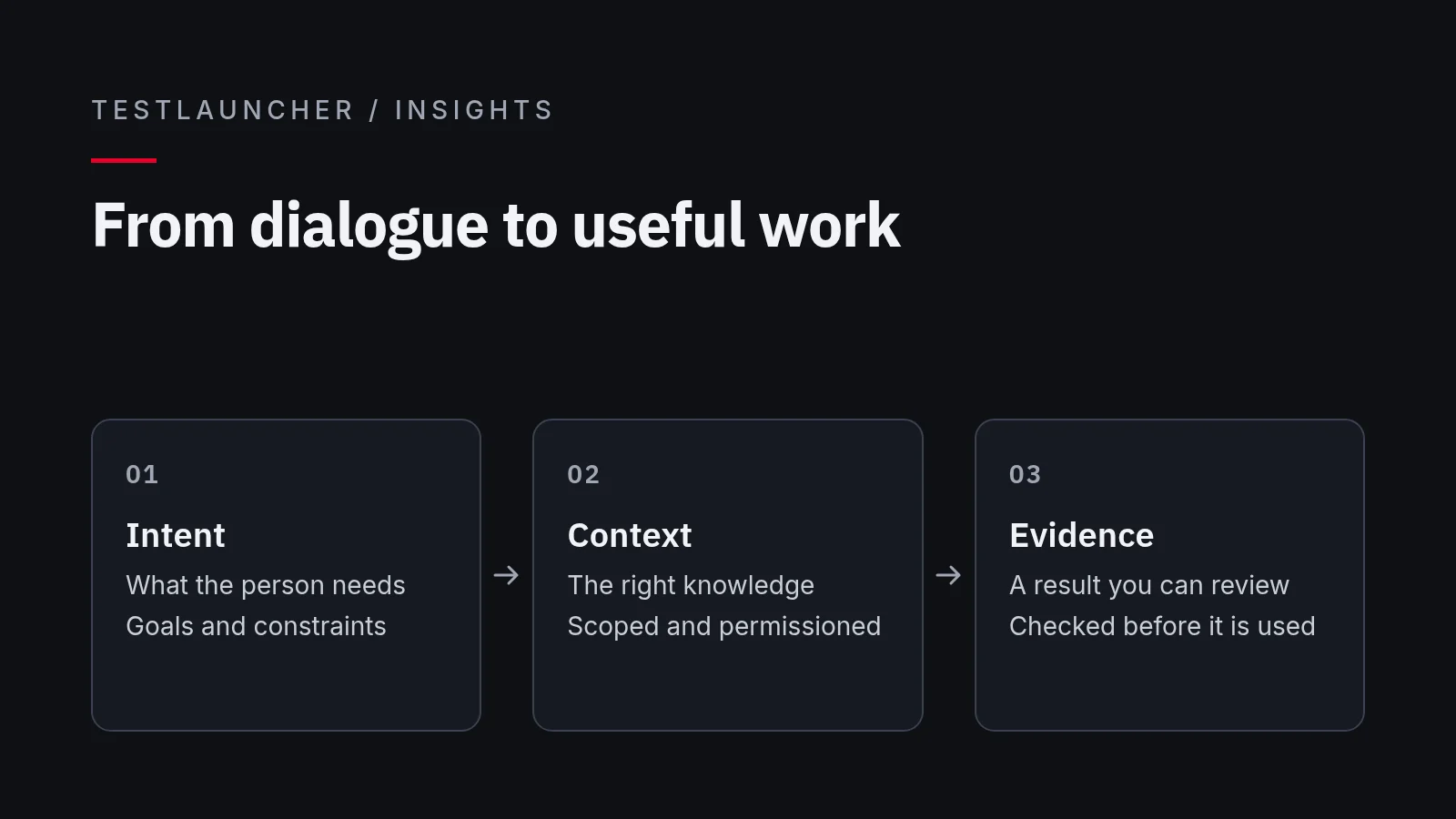
Conversational AI can give people a more direct way to work with complex software: describe the goal, clarify the constraints, and review the result. At TestLauncher, we see an opportunity to make specialized technology easier to use while keeping engineering judgment close to the work.
A useful conversation starts with a problem. A manufacturing team might need to understand why a workflow behaves differently under certain conditions. A clean-technology company might need to investigate an unexpected result. A software team might need to explore what a change means for quality.
Those are examples of the kinds of questions that interest us. The common thread is the distance between what someone needs to accomplish and the systems they must navigate to do it.
Context makes the conversation useful
“Help us investigate this” means very little without knowing what “this” is. The application, its intended behaviour, the observations already collected, and the limits of the task all matter.
Our view is that conversational innovation should reduce the effort of bringing that context together. People should be able to refine a question, challenge an assumption, and understand what supports an answer. A fluent response is a starting point; useful work needs a connection to the actual problem.
This is also why a conversational interface does not automatically replace a specialized platform. The platform still needs to understand its domain, manage access, and preserve the information that makes the work meaningful.
Clear boundaries make progress easier to trust
Conversation can express intent, but it does not remove the need to decide what a system may do. Reading information, proposing a change, and carrying out that change are different responsibilities.
In its engineering guidance on building effective agents, Anthropic distinguishes predefined workflows from systems that dynamically choose their next steps. It recommends starting with simpler approaches and adding complexity when it improves outcomes. That is a useful principle for conversational products too: the interaction should serve the task.
For us, a promising experience should make three things clear:
- The goal: what problem is being addressed, and what would count as a useful result?
- The boundaries: what information and actions are within scope, and where is human approval needed?
- The evidence: what was observed, what remains uncertain, and what should happen next?
These are the design principles guiding our thinking.
Where we apply this
Testing is where we apply these principles first. Our in-house toolkit includes bugAgent, which we use for agentic testing in every sprint. The same three questions shape that work: what is the goal, what is in scope, and what evidence supports the result. Human expertise stays central to deciding what to investigate and what the results mean. See the toolkit.
The problem we want to address is simple to state: helping people move from a technical question to useful, reviewable progress with less friction.
Building for Canadian innovators
As a Canadian software development and innovation company, we are interested in the problems facing teams building ambitious technology here: connected equipment, new approaches to energy, physical AI, and software that must operate under demanding conditions.
Our starting point is the team’s actual challenge. Sometimes the right answer is a custom platform. Sometimes it is a focused integration, an engineering engagement, or better testing of what already exists. Conversational AI should earn its place by making that work easier to understand and carry out.
Privacy belongs in that work too. On our builds, client code and data stay in Canada by default, AI tools run with zero data retention, and nothing is used to train models. Our Security & Privacy page explains how.
If your team has a difficult workflow that could benefit from a more direct way to work with software, book a discovery call. Bring the problem, the constraints, and what a useful outcome would look like.