
$2.41 trillion: the real cost of poor software quality, SaaS to smart factory
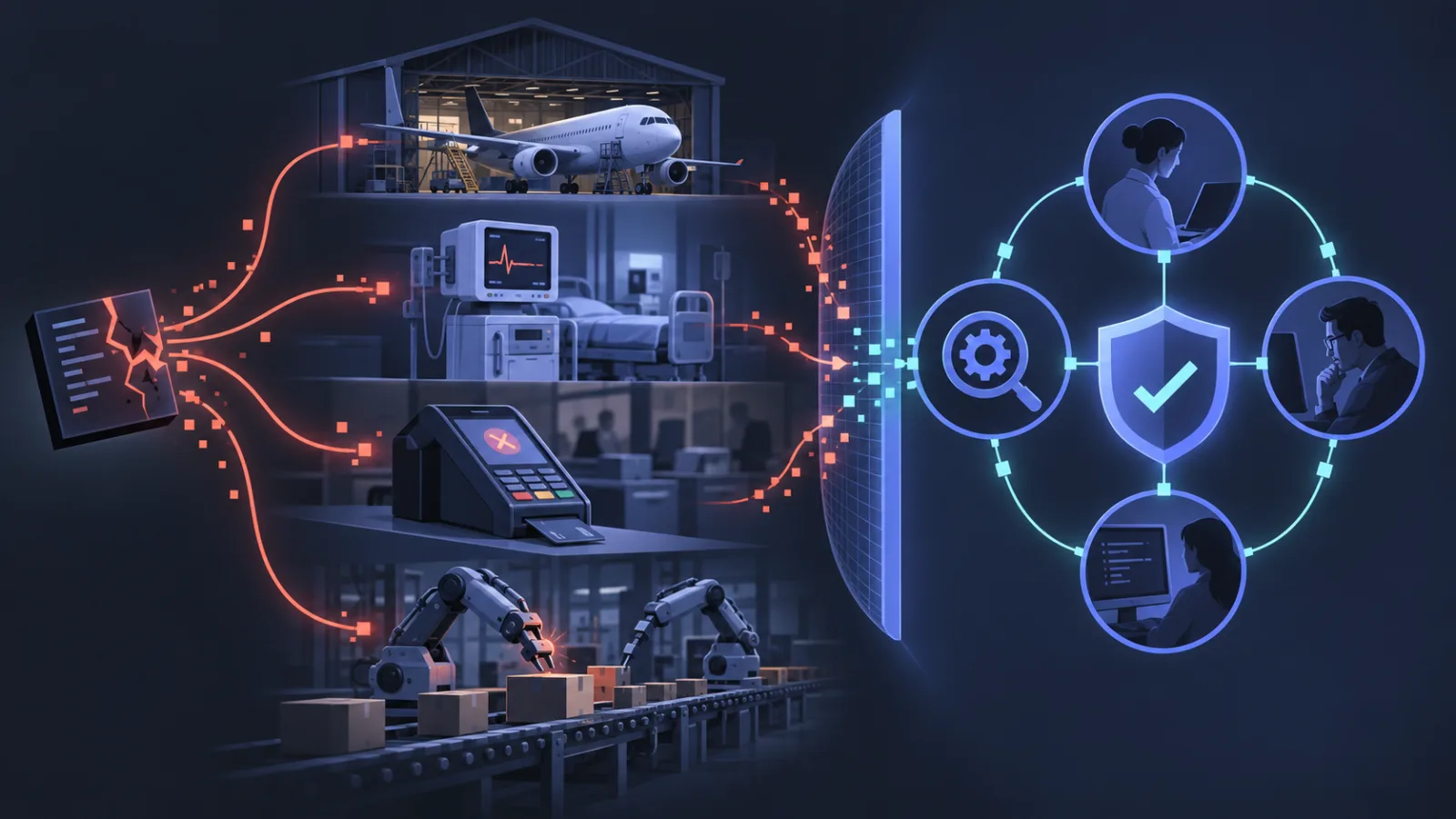
Every business treats software quality as a line item to minimize. The numbers say it is the single largest uncontrolled cost on the balance sheet. The cost of poor software quality in the US reached at least $2.41 trillion, with roughly $1.52 trillion of accumulated technical debt — the biggest single obstacle to changing existing code (CISQ, 2022).
Technical debt behaves like compounding interest: every change gets slower and riskier while the business demands you ship faster. And in a specific class of company, that debt doesn’t just slow you down — it detonates. This is a look at zero-tolerance software quality as a category, why it now reaches from enterprise SaaS all the way to the factory floor, and the one structural choice that separates the companies that compound quality into advantage from the ones that compound it into liability.
”Mostly working” is not a state these companies can occupy
In most software, a defect is a bug ticket. In zero-tolerance industries — aerospace and defense, medical and life sciences, fintech and payments, quantum, robotics, smart manufacturing — an escaped defect is a grounded aircraft, a recalled device, a financial loss, a safety incident, or a regulator’s warning letter. “Mostly working” is not a state these organizations are allowed to occupy.
The thesis of everything below: you either compound your quality data into intelligence, or you compound it into liability. There is no neutral option.
One bad update, $5.4 billion: what CrowdStrike really taught
On July 19, 2024, a single faulty software update took down millions of Windows machines worldwide. It was not a cyberattack — it was a quality-assurance failure in a routine release. The direct losses to Fortune 500 companies reached at least $5.4 billion (excluding Microsoft), and cyber insurance was expected to cover only about 10–20% of it. The financial risk of poor quality lands on the business, not the insurer.
That’s the tail risk. The daily rate is just as sobering: a single hour of downtime now costs more than $300,000 for over 90% of mid-size and large enterprises, and 41% put the hourly cost between $1 million and over $5 million (ITIC, 2024). When those are the stakes, release validation cannot be a checkbox at the end of a sprint. It has to be continuous — which is precisely where autonomous, always-on testing beats point-in-time QA.
Quality, security, and reliability are one problem
Treating quality, security, and reliability as three separate budgets is how the bill gets this large. They are the same problem wearing different badges. The global average cost of a data breach hit a record $4.88 million, up 10% year over year, with 70% of breached organizations reporting significant business disruption (IBM, 2024). Add up breach cost, downtime, and technical debt, and the root cause is the same: siloed tooling that fragments the truth about your product.
The fix is not a fourth tool. It’s a single source of truth about product quality you can prove to an auditor and to a customer — quality, security, performance, and compliance as one owned intelligence layer. You can’t layer intelligence on top of fragmented tooling; the source of truth has to exist first.
The AI-in-QA paradox: adoption is up, stability is down
The counterintuitive part: DORA’s 2024 research found that as AI adoption rose, delivery got worse — an estimated 7.2% drop in delivery stability and a 1.5% drop in throughput, driven largely by AI enabling larger, riskier change batches.
Read that correctly. AI isn’t making software worse; AI-generated code shipped without stronger testing is. More code, faster, in bigger batches, is exactly the condition under which weak quality infrastructure fails. The honest synthesis is that AI raises the bar for autonomous testing — it doesn’t lower it.
Meanwhile the appetite is nearly universal and the execution is not. ~90% of organizations are pursuing generative AI in quality engineering, but only 15% have reached enterprise scale (Capgemini, 2025) — up from a year when 68% were already using GenAI in quality engineering. The momentum is real. The scaling is stuck.
Why GenAI-QA pilots stall at 15% — and how to get past it
The blockers to enterprise scale aren’t model capability. They’re data privacy, hallucination and reliability, and integration complexity — sharpened under regulatory scrutiny. Pilots stall on fragmented, unowned quality data, not on the intelligence of the model.
The way past it is a data-ownership-first architecture: unify your quality signal into one governed layer the AI can safely reason over. That’s what lets AI-in-QA actually reach enterprise scale in regulated environments — and it’s why the accountability layer matters. Governed autonomous testing (bugAgent) plus expert humans in the loop (manualTesting) give you both the speed of agents and the judgment — and audit trail — that zero-tolerance work demands.
Zero-tolerance means the factory floor, too
Software quality stopped being a software-industry problem the moment the factory became a computer. Smart-manufacturing investment is now delivering measured returns: Deloitte’s 2025 survey of 600 US executives reports up to 20% gains in production output and productivity and 15% unlocked capacity. The AI-driven quality step-change is even sharper — the World Economic Forum’s Global Lighthouse sites cut product defects 41%, cycle time 44%, and energy use 28%, with up to half of top use cases powered by AI/GenAI.
But the same Deloitte data exposes the gap: 78% of manufacturers commit more than a fifth of their improvement budget to smart manufacturing, yet only 29% run AI/ML and just 24% have deployed GenAI at the facility or network level. The value is stranded in disconnected MES, QMS, and PLM silos — a data-ownership problem before it’s a model problem, the exact same pattern that stalls software QA pilots.
A digital thread is only as good as the quality woven through it
The factory floor now runs on digital twins, digital threads, and physical AI — and every one of them is a body that a quality brain has to govern and test. Physical AI is already at record scale: 4,664,000 industrial robots are in operation worldwide, up 9% year over year, with 542,000 installed in 2024 alone (IFR, 2025). A digital thread stitches all of that into one lifecycle record — but the thread is only as trustworthy as the quality data running through it. That is the entire premise of qualThread, TestLauncher’s 100-year digital thread: a quality record that outlives the systems, and the people, that created it.
From cost center to compounding asset
Turn the $2.41-trillion narrative into an operating model and the conclusion is unavoidable: own and unify your quality data so detection moves earlier every cycle, and the cost curve bends the other way. That’s the whole stack — a deterministic core (Launch App), autonomous testing, performance, and security (bugAgent), agentic knowledge (qualThread), and expert humans in the loop (manualTesting) — unified into one owned intelligence layer. No incumbent occupies that whitespace, because most of the market is still selling one silo at a time.
For validated, regulated environments, this connects directly to the shift from CSV to risk-based Computer Software Assurance: the same owned-quality-data thesis, applied to compliance.
Frequently asked questions
What is the cost of poor software quality in the US? At least $2.41 trillion, including roughly $1.52 trillion of accumulated software technical debt (CISQ, 2022) — spanning failed projects, legacy problems, operational failures, and cyber incidents.
How much does an hour of enterprise downtime cost? More than $300,000 for over 90% of mid-size and large enterprises; 41% put it between $1 million and over $5 million per hour (ITIC, 2024).
Did the CrowdStrike outage count as a cyberattack, and how much did it cost? No — it was a faulty software update, not an attack. It caused at least $5.4 billion in direct losses to Fortune 500 companies, of which cyber insurance was expected to cover only about 10–20%.
Is AI making software delivery better or worse? DORA’s 2024 research found rising AI adoption correlated with a 7.2% drop in delivery stability — driven by larger, riskier change batches. The lesson isn’t to avoid AI; it’s that AI-generated code demands stronger, autonomous testing.
What is Quality 4.0 and how does it relate to the digital thread? Quality 4.0 applies smart-manufacturing data and AI to quality management. It depends on a trustworthy digital thread — end-to-end lifecycle traceability — which is only as good as the quality data running through it.
Poor quality is a $2.41-trillion tax, and it is paid down one way: by owning the data instead of renting it back from point tools. TestLauncher unifies QA, security, performance, and compliance into one intelligence layer built for zero-tolerance enterprises. Explore the platform, see our approach to security and compliance, or talk to us about turning quality from a cost center into a compounding advantage.